
Website Development for Logistics Companies
F5 develops logistics websites that combine clear service information with working tools: shipment tracking, rate calculators and quote forms, customer portals, and integrations with your CRM and operations systems, on WordPress, Webflow or a custom stack.

10+ years of logistics SEO
We took an online freight forwarder to 1M organic visits a month before its acquisition by Agility.
Logistics companies we work with



Quick answer
What does logistics website development involve?
Logistics website development combines clear service pages with interactive tools: real-time tracking by tracking number, a shipping rate calculator or quote form based on origin, destination, weight and dimensions, and a customer portal for invoices and shipment history. It runs on a CMS such as WordPress or Webflow, connects to your CRM and tracking systems, loads fast on mobile and is tested for speed, SSL security and form delivery before launch.
Most logistics companies do not need to start from scratch. We build on what already works, connect the systems you use and make the site fast, secure and easy for your team to update.
- Team experience
- 10+ years of logistics SEO and marketing, from iContainers (2016) to F5
- Best for
- Freight forwarders, 3PLs, brokers, carriers, customs brokers, logistics SaaS
- Builds
- Tracking, quote and rate tools, customer portals, multi-location sites
- Integrations
- CRM (HubSpot, Salesforce), TMS and tracking APIs, forms, analytics
- Platforms
- WordPress, Webflow, HubSpot CMS, headless or custom
- Standards
- Mobile-first, fast loading, SSL, accessibility, technical SEO
Benefits
Benefits of hiring a logistics web development team
-
Tools customers actually use
Tracking, quote and rate tools and customer portals connected to your TMS, carrier APIs and CRM, built for how shippers work.
-
10+ years of logistics SEO and marketing
The team behind F5 has run logistics marketing since 2016, when Oriol Lampreave joined iContainers and built the inbound engine that reached one million organic visits a month before the acquisition by Agility Logistics. Iván Tintoré has worked in logistics technology since co-founding iContainers in 2008.
-
Rebuilds that keep your rankings
URL mapping, redirects and technical checks before and after launch, so a new site does not lose the search traffic you already have.
-
Fast, secure and easy to update
Mobile-first, SSL, backups and a CMS your team can edit, on WordPress, Webflow, HubSpot CMS or a custom stack.
-
Proof from logistics companies
Interworld Freight, a Miami forwarder, went from referrals to 60 to 80 inbound leads a day. F5 has worked with more than 60 logistics companies and generated more than 5,000 qualified leads for them.
-
Best fit for logistics companies with systems to connect and a site to make faster and easier to run. Not a fit if you need a full TMS built from scratch.
Get my free review
Is your website slow, insecure or hard to update?
We review your stack, speed, forms and integrations and show what to fix, keep or rebuild.
What's included
What logistics website development includes
- 01
Tracking integration
Tracking search connected to your TMS or carrier APIs, with clear status messages.
- 02
Quote and rate tools
Quote forms and rate calculators by origin, destination, weight and dimensions, routed to sales.
- 03
Customer portals
Secure access to shipments, documents and invoices, or clean entry points to your existing portal.
- 04
CRM and system integrations
Forms and events sent to HubSpot or Salesforce, analytics and attribution set up.
- 05
Performance and security
Fast loading, SSL, backups, updates and monitoring as standard.
- 06
Technical SEO and migrations
Clean URLs, redirects, schema and multi-region setups, so a rebuild keeps its rankings.
How it works
How long logistics website development takes, step by step
- Week 1
Technical review
Stack, speed, security, integrations and what to keep.
- Weeks 2–3
Plan
Architecture, tools, integrations and the migration plan.
- Weeks 4–10
Build and test
Development, integrations, redirects, speed and security tests.
- After launch
Maintain
Updates, monitoring, backups and improvements.
Build plan
The tools a logistics website should run
Buyers and customers come to a logistics website to do something: get a price, check a shipment, find a document. These are the tools worth building.
- 01
Quote form or rate calculator
What it does: Collects origin, destination, weight, dimensions, Incoterms; returns a range or routes the request
Connects to: CRM, sales inbox, pricing rules
Value: More and better RFQs
- 02
Shipment tracking
What it does: Search by tracking or reference number with status updates
Connects to: TMS, carrier or tracking APIs
Value: Fewer "where is my cargo" calls
- 03
Customer portal
What it does: Shipment history, documents, invoices, saved addresses
Connects to: TMS, ERP, accounting
Value: Retention and self-service
- 04
Location finder
What it does: Terminals, warehouses and offices with services and hours
Connects to: Maps, CMS
Value: Local search and conversions
- 05
Content and SEO engine
What it does: Templates for lane, service and location pages at scale
Connects to: CMS, analytics
Value: Rankings and AI citations
Want a technical plan for your website?
Get my free technical reviewCase study
Logistics website results: Interworld Freight
Interworld Freight: from referrals to 60–80 inbound leads a day

- Miami, FL
- International freight forwarder
- Caribbean and Bahamas lanes
A strong operation on Caribbean and Bahamas routes out of Miami, but a website with no organic traffic and no lead capture. New clients came through relationships, so growth had a ceiling.
A rebuilt, technically sound website; SEO aimed at shippers moving cargo to Caribbean destinations; and lead capture designed around how a freight buyer decides.
60 to 80 inbound leads a day. The website is now Interworld's primary business development channel, running 24/7 without a sales team behind it.
- 1Mmonthly visits at iContainers
- +5,000qualified leads for clients
- +60logistics companies

"F5 rebuilt our website page by page, put a form on every service page so we know where each lead comes from, and they understand tariffs and trade compliance well enough to write about it."
Work
Logistics websites we have designed and built.
-
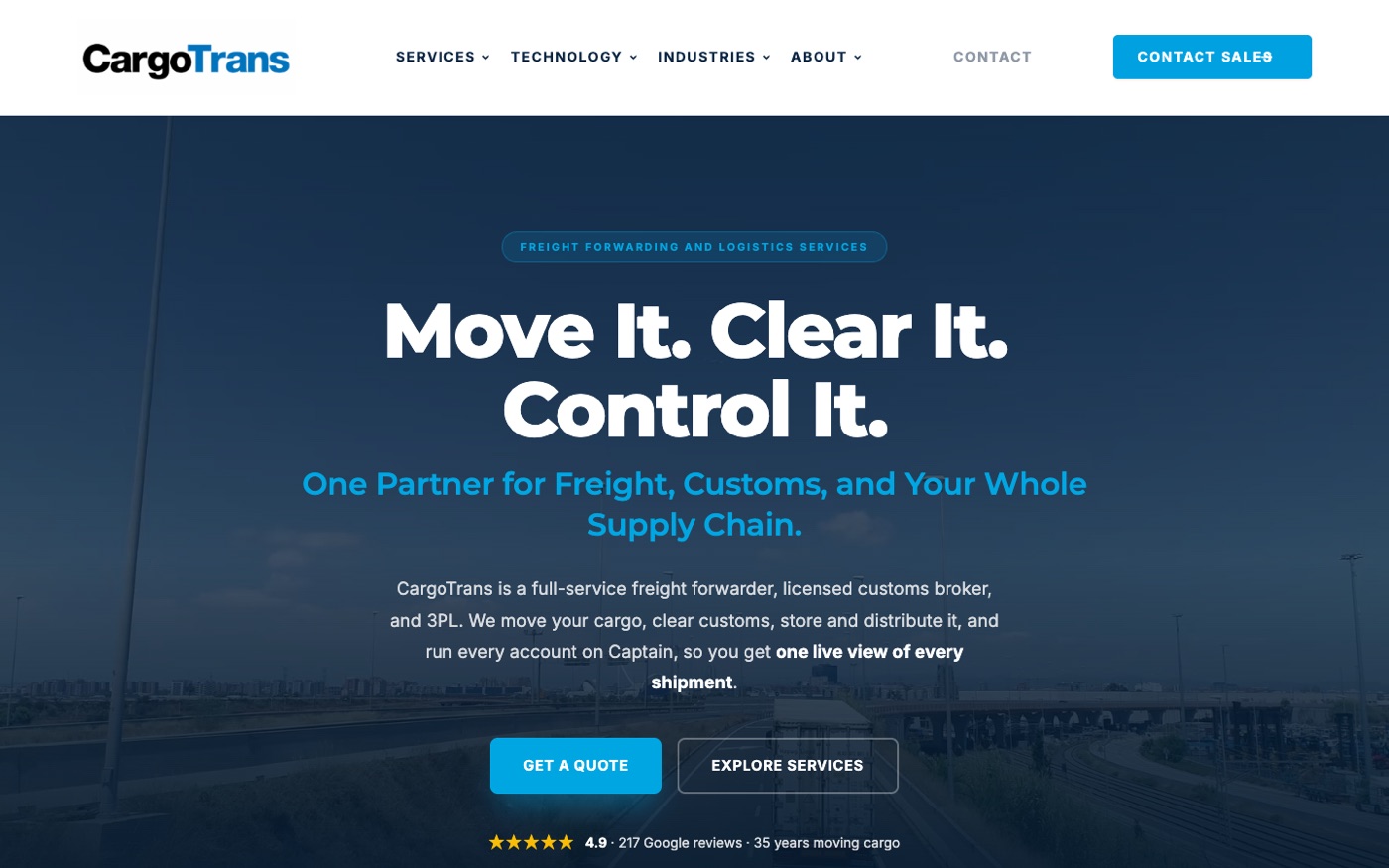
CargoTrans
cargotransinc.comCustoms broker & 3PL · New York
- Before
- A 35-year-old business that looked like a small family broker online. Services buried, no pages for the lanes shippers search, and a quote form that attracted one-off shipments.
- Fixed
- Clear message (freight, customs and 3PL under one partner), a professional look, a page for every service and lane, and a discovery-call CTA that brings the right clients.
-
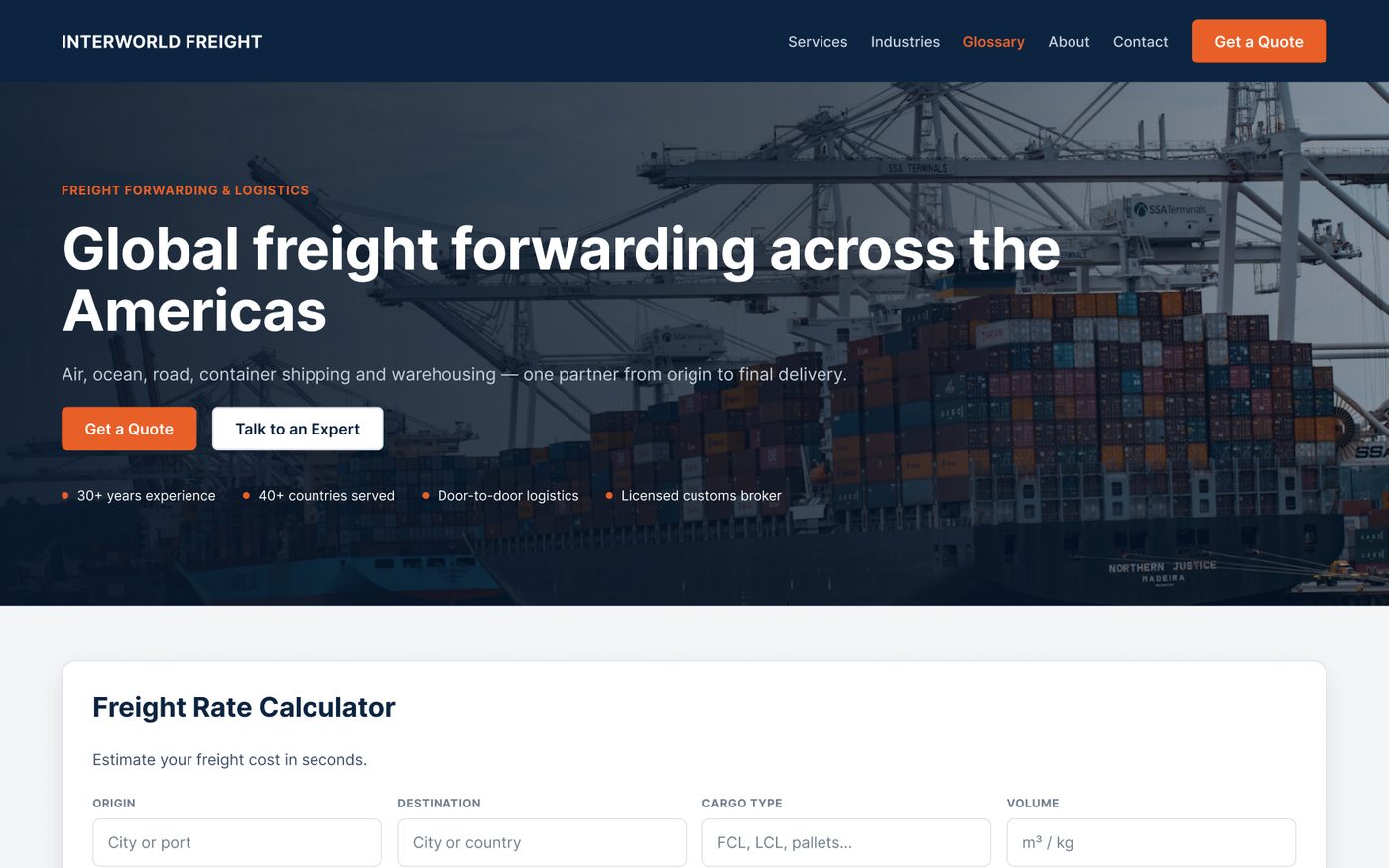
Interworld Freight
interwf.comFreight forwarder & NVOCC · Miami
- Before
- Hundreds of pages squeezed into two templates, a dated look and no way for a shipper to tell what they do or where they ship.
- Fixed
- A design system and a template for every kind of page (services, destinations, industries), a clear message for the Americas and the Caribbean, and a quote calculator as the conversion point.
-
Trucks on the Map
trucksonthemap.comFreight management platform · UK
- Before
- A strong product with no website behind it, and a message that only made sense to people who already knew the tool.
- Fixed
- Built from zero around the four problems a transport planner has, with a page per module, a professional look that matches the software, and demo booking as the goal.
-
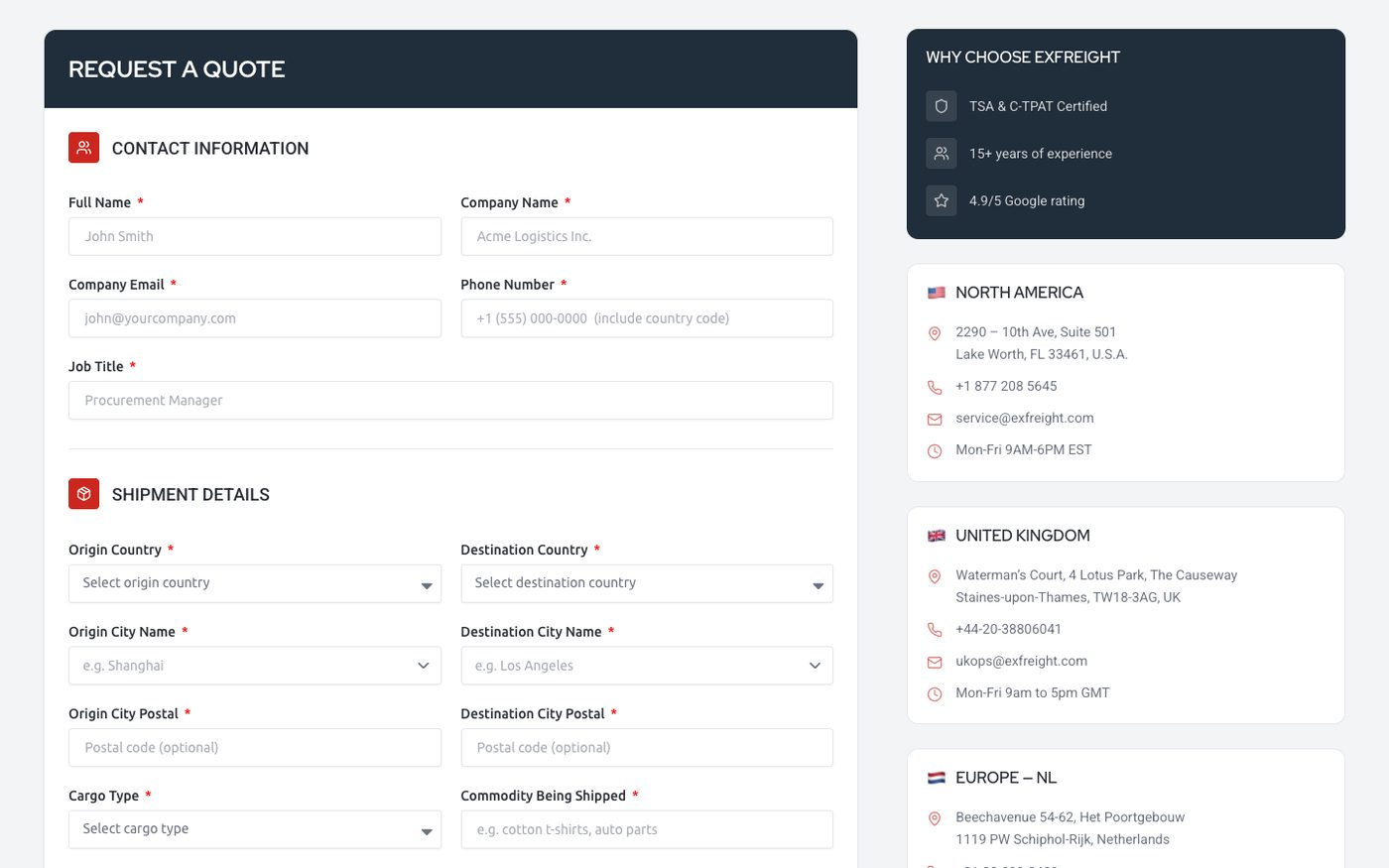
ExFreight
exfreight.comFreight forwarder · Florida
- Before
- A site broken by a failed update, a dated theme and a quote process with too much friction for a company that sells instant rates.
- Fixed
- Rebuilt clean, service pages that explain each option in plain terms, a quote flow that takes a minute, and tracking so every RFQ is counted.
Compare
A logistics web team, a freelancer or a generalist dev shop?
Short answer: Freelancers are affordable for small sites; generalist dev shops build well but need logistics explained. A logistics web team knows the tools shippers expect and builds them with SEO and conversion in mind.
| F5 | Freelancer | Generalist dev shop | |
|---|---|---|---|
| Knows tracking, quotes and portal needs | Yes | Rarely | If briefed |
| CRM and TMS integrations | Yes | Varies | Yes |
| SEO-safe migrations and redirects | Yes | Often missed | Varies |
| Conversion and content strategy | Built in | No | Rarely |
| Ongoing maintenance | Available | Depends on availability | Yes |
Pricing
How much logistics website development costs
Logistics website development is priced as a project, with optional monthly maintenance, and depends on the tools and integrations you need. F5 quotes after a free technical review and a 30-minute call.
Get a project quoteWhat changes the price
- Tools: tracking, quotes, portal, location finder
- Integrations: TMS, carrier APIs, CRM
- Migration and redirects
- Maintenance after launch
Monthly programs and projects, scoped to you. Every page, account and report we create is yours.
By industry
Website development for each type of logistics company
The tools that matter depend on what customers come to do.
-
Development for freight forwarders
Quote flows with Incoterms, tracking and document access.
Freight forwarders -
Development for 3PLs
Location finders, integration pages and client portals.
3PLs and fulfillment -
Development for freight brokers
Shipper quote and carrier onboarding flows.
Freight brokers -
Development for trucking companies
Lane and terminal pages plus driver application flows.
Trucking and drayage -
Development for customs brokers
Fast publishing for regulatory updates and secure document intake.
Customs brokers -
Development for shipping lines and ports
Schedules, routes and booking entry points.
Ocean shipping and ports -
Development for supply chain software
Docs, integrations and demo flows built for scale.
Supply chain technology -
Not on the list?
Tell us what you move
Who works on your account
Who builds your website
10+ years of logistics SEO and marketing, from iContainers to F5. No account-manager layer: the founders plan your program and review every page before it ships.

Iván Tintoré
Co-founder
Coming from a logistics and business background, Iván co-founded iContainers (sold to Agility Group). He’s been coupling logistics and technology for 15+ years.
LinkedIn
Oriol Lampreave
Co-founder
Marketing and data geek. Oriol joined iContainers young and grew with the business, becoming CMO and shaping the company’s entire inbound strategy until its exit.
LinkedInFAQ
Logistics website development FAQ
What are the essential features of a logistics website?
+
What are the essential features of a logistics website?
+Service pages, a quote form or rate calculator, shipment tracking, a customer portal or portal entry, location pages and fast mobile performance. Tracking and quotes are the tools customers use most.
Which CMS is best for a logistics company?
+
Which CMS is best for a logistics company?
+WordPress for flexibility and plugins, Webflow for design control and easy editing, HubSpot CMS for teams already in HubSpot, and headless or custom builds for complex portals.
Can you integrate shipment tracking into our website?
+
Can you integrate shipment tracking into our website?
+Yes, through your TMS, carrier or tracking provider APIs, or a clean link to your existing tracking portal when an API is not available.
Will a rebuild hurt our Google rankings?
+
Will a rebuild hurt our Google rankings?
+Not if the migration is planned: URL mapping, redirects, preserved content and technical checks before and after launch. That is part of every project. See our logistics SEO agency work.
Do you maintain the website after launch?
+
Do you maintain the website after launch?
+Yes. We offer updates, monitoring, backups and continuous improvement, or hand over to your team with documentation.
Do we need to start from scratch?
+
Do we need to start from scratch?
+Rarely. Most logistics websites can keep their platform and content that works, with new templates, tools and integrations on top.
Guides from the team
Page reviewed by Oriol Lampreave · Updated October 2026
Free technical review
See what to fix, keep or rebuild
In two business days: your stack, speed, security, forms and integrations reviewed, with a plan for the tools worth building.
- Speed and security check
- Forms and CRM integration review
- Tracking and portal options
- Walkthrough on a 30-minute call
Prefer to talk now? Pick a 30-minute slot or write to hi@f5-out.io.